Top Signs You Need Windows & Doors Service – Don’t Ignore These
The sign most homeowners wait too long on isn’t visible at all. It’s the air conditioner cycling more often in July without a single change on the thermostat, a pattern that often traces straight back to failed window seals on south- and west-facing glass. Roseville summers push HVAC hard for six months, and a compromised window or door quietly adds to every bill while the damage compounds underneath. If you’d rather not crawl around testing seals yourself, call (279) 529-6442 and we’ll take a look.
Key Takeaways
- Condensation between the panes means the seal has failed; condensation on the glass is usually a humidity issue.
- A five-minute incense or tissue test shows you exactly where a window or door is leaking air.
- Paint bubbling and frame discoloration usually point to water behind the frame, not just cosmetic wear.
- A window that binds or a door that won’t latch can signal frame racking or foundation movement.
- Late summer and early fall, after months of thermal stress, are when the worst problems surface in Roseville.
Condensation Between the Panes vs. On the Glass
Not all foggy glass means the same thing, and knowing which kind you have saves you from guessing. Surface condensation is moisture from the air settling on cool glass. It wipes away, it’s usually worst in the morning or during a humid stretch, and it often clears when indoor humidity drops. Condensation between two panes in a double- or triple-glazed unit is a different animal entirely: it means the seal on that insulated glass unit has failed and the inert gas or dry air inside has been replaced by outside moisture.
How to tell the difference:
- Wipe test: If a cloth removes the fog from the outside, it’s surface condensation. If the fog stays trapped behind the glass, the seal is gone.
- Etching and haze: A failed seal over time leaves a milky or whitish film that won’t wipe off at all. That’s mineral staining on the inner glass surfaces.
- Location: Surface condensation tends to appear on the coldest glass in the house, often in bathrooms and kitchens. Seal failure can happen to any unit.
In our experience, a failed insulated glass unit is a replacement job, not something you can dry out or patch. The glass assembly has to come out and new glazing go in. When we’re specifying the fix, we look at impact-rated options through lines like PGT alongside thermally efficient units, because the right product for your opening depends on which problem you’re actually solving. A west-facing window that bakes all afternoon has different needs than a shaded north window.
The Incense and Tissue Air-Infiltration Test
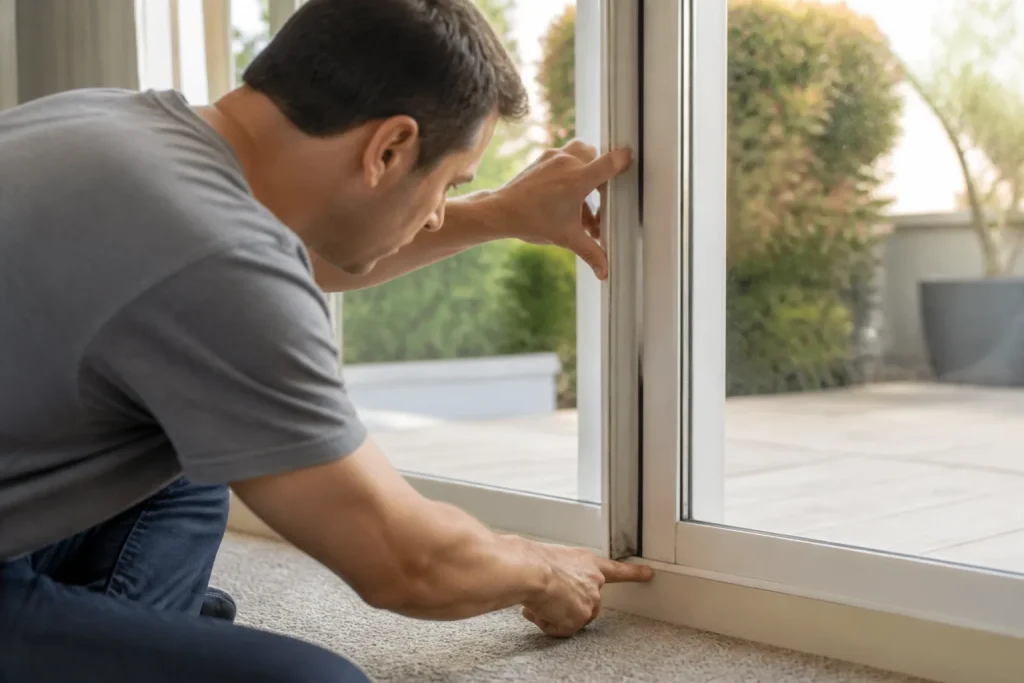
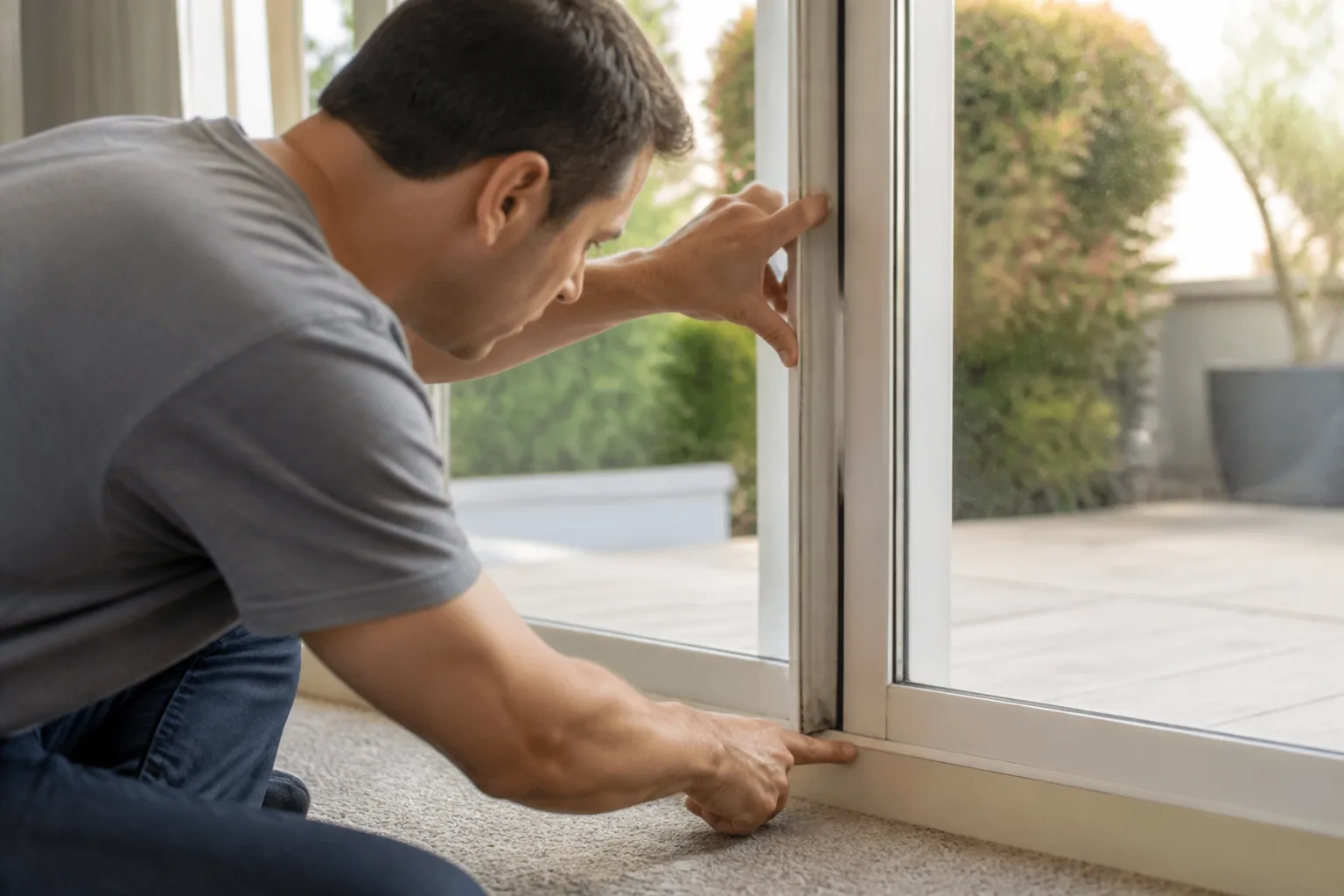
You can find the drafty spots in your home in about five minutes with a stick of incense or a single square of tissue. Run it slowly along the perimeter of a closed window or door – the sash edges, the frame corners, the weatherstripping, the sill. If the smoke or tissue wavers, you’ve found an air leak. Do this on a windy day if you can, and test every opening on the south and west sides of the house where summer sun does the most work.
What the result means in a Roseville summer:
- Small flicker at one corner: usually worn weatherstripping or a minor seal gap.
- Steady pull along a whole edge: the sash isn’t meeting the frame properly, often from a settled or warped unit.
- Leak at multiple openings: the windows themselves are past their sealing life.
Here’s the energy math that matters: every cubic foot of cooled air that escapes through a gap is air your system already paid to chill. When the AC runs hard for months, a handful of leaky openings can add real money to the monthly bill. The draft is the symptom; the cost is what shows up in the statement. That said, a tissue test tells you where air is moving, not always why. That’s the point where a specialist can read the frame for you.
Frame Discoloration and Paint Bubbling: Water Behind the Frame
Paint bubbling along a window frame or door casing is almost never just an aging finish. Bubbled, blistered paint is trapped moisture pushing outward from behind the surface, and it usually means water has gotten past the exterior seal into the wood or substrate underneath. Discoloration – dark streaking, a chalky bloom, or soft gray patches on the frame – tells the same story more quietly. By the time you can see it, the damage has often been working on the frame for a while.
What to look for around Roseville homes:
- Bubbling paint on the interior sill or the exterior casing near the corners.
- Soft or spongy wood when you press a fingernail into the frame.
- Water staining on drywall below the window or beside the door.
- Peeling caulk that keeps coming back after you reapply it.
Aesthetic wear is cosmetic; intrusion is structural, and it gets more expensive the longer it stays wet. When we specify replacements, the goal is a complete opening, not a surface patch – new frame, new flashing detail, new glazing that fits the conditions. Fiberglass options such as Therma-Tru entry doors handle moisture exposure well, and the same logic applies to window frames. If you see bubbling or dark streaking, it’s worth an inspection before the wet season.
Binding, Sticking and Doors That Won’t Latch: Frame Racking
A window that requires two hands and a hip check to close, or a door that won’t latch without lifting it, is telling you the frame is no longer square. This is called racking. The opening has shifted out of true, and the moving parts inside it scrape, bind, and fight you every time you use them. It’s easy to blame the hardware. More often the hardware is fine and the frame around it has moved.
Racking can come from a window or door that has warped from years of heat and sun, a settling frame, or – in the cases worth taking seriously – movement in the structure itself. Watch for:
- Grounds for a window or door problem: one opening is stiff, the rest close cleanly, the binding started after a hot summer.
- Grounds to look at the structure: multiple doors and windows bind at once, doors won’t latch at all, you notice cracks or sloping floors nearby.
If it’s a single binding opening, replacement of that window or door usually solves the operation problem completely. If several openings act up at once, get the structure checked before you replace anything, because a new window in a moving frame will eventually do the same thing. That’s the honest trade answer, and anyone who skips telling you so isn’t doing you a favor.
Why Roseville’s Thermal Cycling Makes Annual Checks Worth It
Roseville glass lives under real seasonal stress. Summer delivers long stretches of intense sun and triple-digit afternoons; winter brings mild, damp months. Every year windows and doors expand in the heat and contract as evenings cool, and that cycling is what wears out seals, loosens hardware, and exposes weak flashing. The problems don’t announce themselves in the middle of July – they surface in late summer and early fall, after months of thermal stress have done their quiet work.
A short annual quick-check catches them early:
- Look at every pane for trapped condensation or haze.
- Test each opening’s operation – does it close smoothly and latch fully?
- Scan frames and casings for bubbling paint, dark streaks, or soft wood.
- Feather an incense stick along the perimeter of south- and west-facing windows.
Ten minutes in early fall tells you whether you have a quiet problem or none at all. Do it before the wet season rather than after, and note anything that looks like intrusion so it can be checked properly. Small catches stay small catches; ignored ones turn into framing work.
When to Call a Pro
Some signs you can diagnose yourself, and some you shouldn’t. Call a specialist when you find condensation trapped between panes, when paint bubbling or soft wood shows water has gotten into the frame, when multiple openings are binding at once, or when a door that used to close cleanly now needs force. Those go beyond a weatherstripping swap and point to a window or door that needs replacing.
We work only in replacement, not new construction or general remodeling, so the job here is straightforward: find the failing opening and replace it right. Our technicians have up to 13 years of experience, and an unusually wide set of manufacturer partners – PGT, ViewLux, Mr-Glass and Therma-Tru among them – means we specify the product after we understand the problem. If you’re weighing a single failing window against a whole-house project, we’ll tell you plainly which makes sense. We do ask that replacement jobs cover three openings or more, since that’s where the work is worth doing well.
Related services in Roseville: If your issue points to the glass, see our window replacement page; for a sticky or failing entry, our door replacement page covers the trade-offs. For new units going in, we’ve laid out what window installation involves, and you can see everything we do at Roseville Window Replacement Pros.
The Bottom Line
The warnings that matter most are the ones that don’t look urgent: fog between the panes, a tissue that wavers at the sash, bubbling paint, a door that needs a shoulder. In a climate where the AC runs hard for half the year, those small signs are costing you every month while the frame keeps getting worse. Catch them in early fall and most turn into a clean, contained replacement rather than a bigger job. If you’re in Roseville and want a straight answer about what your windows and doors actually need, Roseville Window Replacement Pros offers free estimates – call (279) 529-6442. And if all this talk of incense tests and sagging doors makes you want to spend your Saturday afternoon somewhere else, we understand completely.
Frequently Asked Questions
If the fog is between the panes and won’t wipe off, the insulated glass unit has failed and it needs replacement. Surface condensation that wipes away is usually a humidity issue you can fix with ventilation. Either way, call (279) 529-6442 for a free look – estimates cost you nothing.
Not always. A wavering incense flame at one corner can be worn weatherstripping, but a steady pull along a whole edge usually means the unit isn’t sealing properly and is due for replacement. The fastest way to know is an on-site check. Call (279) 529-6442 for a free estimate.
A door that won’t latch usually means the frame has shifted out of square, a condition called racking. If one door is affected, replacing it often solves it. If several openings bind at once, get the structure checked first. Call (279) 529-6442 to schedule a free estimate.
Most surface in late summer and early fall, after months of heat and thermal cycling have stressed seals and frames. A ten-minute check each fall catches them before the wet season. Call (279) 529-6442 if anything looks off.
Written by the team at Roseville Window Replacement Pros.
Need Windows & Doors Help?
Call Roseville Window Replacement Pros - the local pro we connect you with is licensed and insured, here with fast after-hours help in Roseville.
(279) 529-6442